
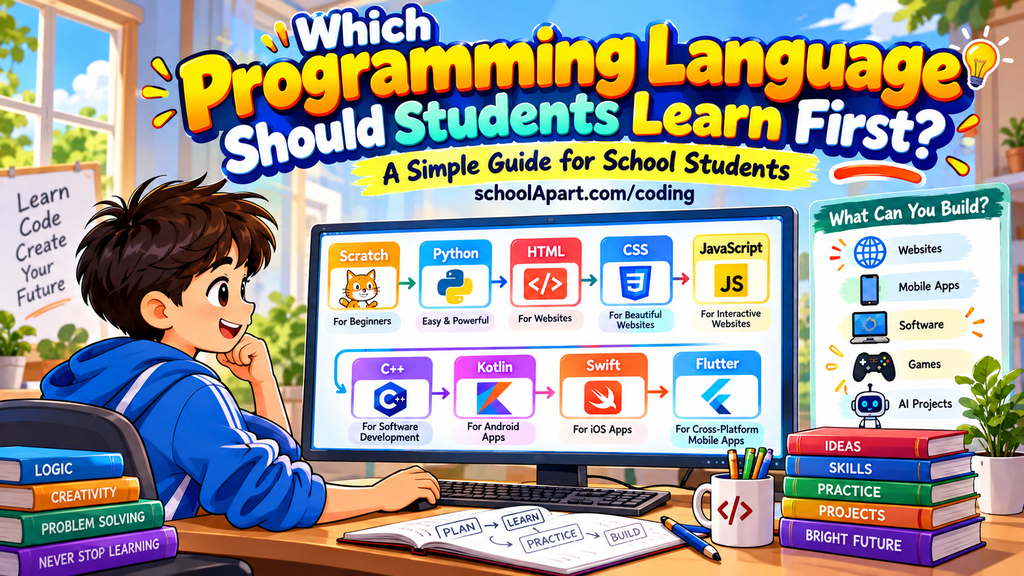
Which programming language should students learn first? Explore Scratch, Python, JavaScript, C++, and more to find the right starting point for school students.
Which Programming Language Should Students Learn First?
Learning coding can be an exciting journey for school students. It helps them understand how computers work, solve problems, and turn their ideas into real projects.
But when students decide to learn coding, one important question comes up: Which programming language should students learn first?
There are many programming languages, including Python, JavaScript, C++, Java, Kotlin, and Swift. Each language has different uses, and students do not need to learn all of them at once.
The best choice depends on a student’s current knowledge, interests, and what they want to create.
In this guide, you will learn which programming language or technology to start with for coding, websites, mobile apps, software, games, and artificial intelligence.
What Is a Programming Language?
A programming language is a way to give instructions to a computer. Programmers write instructions that tell computers how to perform different tasks.
For example, a program can tell a computer to:
- Display a message.
- Add two numbers.
- Ask questions and check answers.
- Create a simple game.
- Make a website interactive.
- Process information.
- Perform calculations automatically.
Python, JavaScript, C++, and Java are examples of programming languages.
HTML and CSS are also important for website development, but they are not programming languages. HTML defines the structure of a webpage, while CSS controls its appearance and layout.
Which Programming Language Should Students Learn First?
There is no single programming language that is best for every student.
For complete beginners, Scratch can be an excellent starting point. Students who are ready to type and understand code can consider Python.
Students interested in building websites, mobile apps, games, or other software may eventually need different languages and tools.
The best approach is to start with one suitable option, learn the basics, and then follow a learning path based on your interests.
Choose a Starting Point Based on Your Goal
| Your goal | What you can learn first |
|---|---|
| Learn coding from scratch | Scratch |
| Learn text-based programming | Python |
| Create websites | HTML → CSS → JavaScript |
| Build web applications | HTML, CSS and JavaScript, followed by a backend technology |
| Develop Android apps | Kotlin |
| Develop iPhone and iPad apps | Swift |
| Build apps for Android and iOS | Dart with Flutter |
| Explore software development | Python, Java, C++ or C# |
| Create games | Scratch initially, then C# or C++ depending on the tools used |
| Learn competitive programming | Python or C++, depending on the learning level and goals |
| Explore AI and machine learning | Python |
| Learn data science | Python |
These are suggested starting points, not strict rules. Students can choose different paths depending on their interests and previous experience.
1. Scratch: A Good Starting Point for Complete Beginners
Scratch is a visual programming platform designed to help beginners understand coding concepts.
Instead of typing every instruction, students connect colourful blocks to create programs. This makes it easier to experiment with instructions and see what happens.
With Scratch, students can create:
- Simple games
- Animations
- Interactive stories
- Quizzes
- Small educational projects
Scratch also introduces important programming ideas such as sequences, loops, conditions, and variables.
Who should start with Scratch?
Students who have never tried coding before and want to learn through visual projects may find Scratch especially helpful.
2. Python: A Good First Text-Based Programming Language
Python is a popular programming language known for its relatively readable syntax. It is widely used in automation, data science, artificial intelligence, and many other areas.
Students can use Python to learn:
- Variables and data types
- Conditions
- Loops
- Functions
- Lists
- Simple calculations
- Basic games and projects
For example, a student can gradually learn to write a program that adds numbers, checks answers in a quiz, or runs a number-guessing game.
Who should start with Python?
Students who are ready to write code using a keyboard and want to learn general-purpose programming can consider Python.
3. HTML, CSS and JavaScript: For Students Who Want to Build Websites
If your goal is to create websites, learning HTML, CSS, and JavaScript is a practical starting point.
These technologies have different roles.
HTML: Build the Structure
HTML defines the structure and content of a webpage, such as headings, paragraphs, links, and images.
CSS: Design the Website
CSS controls how a webpage looks, including colours, fonts, spacing, and layout.
JavaScript: Add Interactivity
JavaScript allows developers to add interactive features, such as buttons, form validation, menus, and dynamic content.
A beginner-friendly learning path is:
HTML → CSS → JavaScript
After learning these basics, students can explore more advanced web development topics when they are ready.
4. Which Languages Should Students Learn for Web Application Development?
A web application is more than a webpage that displays information. It may allow users to sign in, submit forms, save information, or interact with online services.
Students can begin with HTML, CSS, and JavaScript. Later, they can learn backend programming to understand how websites process information and communicate with databases.
Common backend options include:
- Python
- JavaScript with a backend runtime
- PHP
- Java
Students do not need to start with advanced frameworks such as Django, Laravel, or Spring. Understanding basic programming and web technologies first will make those frameworks easier to learn later.
5. Which Programming Language Should Students Learn for App Development?
Mobile app development offers several learning paths.
Kotlin for Android Apps
Kotlin is a modern programming language used for Android development. Students interested in creating Android apps can explore it after learning basic programming concepts.
Swift for Apple Apps
Swift is used to develop apps for Apple platforms, including iPhone and iPad. It is an option for students interested in Apple’s app ecosystem.
Dart and Flutter for Cross-Platform Apps
Flutter is a development framework that uses the Dart programming language. It allows developers to build apps for multiple platforms using a shared codebase.
A useful learning path is to understand basic programming first and then choose Kotlin, Swift, or Dart with Flutter according to the type of app you want to build.
6. Which Languages Are Useful for Software Development?
Software development includes creating programs and applications for different purposes. These might include desktop software, educational tools, business applications, or utilities.
Different projects use different technologies.
- Python: Useful for beginner projects, automation, and many general-purpose applications.
- Java: Used in enterprise applications and many other software systems.
- C++: Useful in performance-sensitive software and certain game development projects.
- C#: Used in application development and game development with tools such as Unity.
Students should not try to learn all these languages immediately. They can begin with Scratch or Python, understand programming fundamentals, and explore other languages as their interests develop.
7. Which Language Should Students Learn for Game Development?
Game development combines programming with design, graphics, sound, and gameplay.
Scratch is a good way for beginners to create simple games and understand game logic.
Later, students can explore:
- C#: Commonly used with the Unity game engine.
- C++: Used in various performance-intensive applications and game development environments.
The right choice depends on the game engine and the type of game a student wants to create.
8. Which Programming Language Is Useful for AI and Machine Learning?
Python is one of the most widely used programming languages for artificial intelligence and machine learning.
Students interested in AI can follow this path:
Python basics → Programming concepts → Data handling → Introductory AI and machine learning
Learning the basics first helps students understand the code behind AI tools rather than simply using them.
Students do not need to build advanced AI systems immediately. Small programming exercises and projects are a useful starting point.
9. Should Students Learn C++ for Competitive Programming?
C++ is a popular choice for competitive programming because it provides useful features for solving algorithmic problems efficiently.
Students can use competitive programming to practise:
- Logical thinking
- Problem-solving
- Algorithms
- Data structures
- Writing and testing solutions
Python can also be a good starting point for learning problem-solving. Students can choose C++ later if they want to explore competitive programming more deeply or need its performance advantages.
Scratch vs Python vs JavaScript vs C++
| Technology | Best suited for | Beginner difficulty |
|---|---|---|
| Scratch | Visual coding, games and animations | Very beginner-friendly |
| Python | General programming and beginner projects | Beginner-friendly |
| JavaScript | Interactive websites | Requires learning web concepts |
| C++ | Competitive programming and certain software or game projects | Often more challenging initially |
Difficulty depends on a student’s experience, learning resources, and practice. No language is impossible for a school student to learn.
Should Students Learn More Than One Programming Language?
Yes, but beginners usually benefit from focusing on one language or technology at a time.
Trying to learn Python, JavaScript, C++, and Java simultaneously can make it harder to understand the basic concepts.
A more effective approach is:
- Choose one starting point.
- Learn the basic concepts.
- Practise with small exercises.
- Create a simple project.
- Explore another language when your goals require it.
Once students understand concepts such as variables, conditions, loops, and functions, learning another language often becomes easier.
What Should Students Know Before Learning Coding?
Students do not need advanced computer knowledge to begin coding.
Some useful basic skills include:
- Using a keyboard and mouse or touchpad
- Opening and saving files
- Using a web browser
- Following instructions
- Breaking a problem into smaller steps
Curiosity, patience, and regular practice are more important than knowing complicated mathematics at the beginning.
Students should also use age-appropriate learning platforms and follow their school or family’s online safety guidance.
A Simple Coding Learning Path for School Students
Here is a practical way to begin:
Step 1: Understand coding. Learn what programs do and how instructions work.
Step 2: Choose a starting point. Try Scratch if you prefer visual blocks, or Python if you are ready to type code.
Step 3: Learn the fundamentals. Practise variables, conditions, loops, and functions.
Step 4: Build small projects. Try a quiz, calculator, animation, or number-guessing game.
Step 5: Choose an area of interest. Explore websites, mobile apps, software, games, or AI.
Step 6: Learn the tools for that area. For example, learn HTML and CSS for websites or explore Kotlin for Android development.
Step 7: Keep practising. Improve existing projects and gradually try more challenging tasks.
Final Answer: Which Programming Language Should Students Learn First?
The best first programming language depends on what a student wants to learn.
- Start with Scratch if you are completely new to coding.
- Choose Python if you want to learn text-based programming.
- Learn HTML, CSS, and JavaScript if you want to create websites.
- Explore Kotlin, Swift, or Dart with Flutter for mobile app development.
- Consider Python, Java, C++, or C# for different software development goals.
- Explore C# or C++ for game development, depending on your chosen tools.
- Learn Python if you are interested in AI and data science.
You do not need to learn every programming language. Start with one, practise regularly, and build something simple.
The real goal is not to memorise programming languages. It is to learn how to solve problems and turn your ideas into something useful with technology.
FAQ
1. Which programming language should students learn first?
Scratch is a good starting point for students who are completely new to coding. Python is a useful option for students ready to learn text-based programming.
2. Is Python good for school students?
Yes. Python has relatively readable syntax and can help students learn programming fundamentals and create small projects.
3. Should students learn Scratch or Python first?
Scratch is useful for visual, block-based learning. Python is suitable for students who are ready to type and understand code. The choice depends on the student’s experience and goals.
4. Is HTML a programming language?
No. HTML is a markup language used to structure webpage content.
5. Is CSS a programming language?
No. CSS is a stylesheet language used to control webpage appearance and layout.
6. Which languages are used for website development?
HTML and CSS are used to structure and style webpages, while JavaScript adds interactivity. More advanced web applications may also require backend technologies.
7. Which programming language is used for app development?
Kotlin is used for Android development, Swift is used for Apple platforms, and Dart with Flutter can be used to build cross-platform apps.
8. Which programming language is useful for AI?
Python is widely used in AI and machine learning. Students should first learn basic programming concepts before exploring advanced AI topics.
9. Can school students learn C++?
Yes. Students can learn C++ with suitable guidance and practice. It can be useful for competitive programming and certain software development projects.
10. Do students need to learn multiple programming languages?
No. Beginners can focus on one language first, learn the fundamentals, and then explore additional languages according to their interests.
Leave a Reply