

Learn how to improve your sketching skills with practical beginner-friendly tips, observation exercises, line practice, proportion, shading, and a simple daily routine.
How to Improve Your Sketching Skills: Practical Tips for Beginners
Meta Description: Learn how to improve your sketching skills with practical beginner-friendly tips, observation exercises, line practice, proportion, shading, and a simple daily routine.
Slug: improve-sketching-skills
Sketching is a skill that improves through observation, practice, and patience. You do not need to be naturally talented to become better at sketching. With the right practice methods, beginners can gradually improve their lines, shapes, proportions, shading, and ability to draw what they see.
Many beginners practice by drawing the same type of picture repeatedly. While practice is important, how you practice matters too.
A better approach is to identify specific skills, practice them separately, and then use them together in complete sketches.
In this guide, you will learn practical ways to improve your sketching skills, common mistakes to avoid, useful exercises, and a simple daily routine for beginners.
What Does It Mean to Improve Your Sketching Skills?
Improving your sketching skills means becoming better at observing and representing subjects with lines, shapes, values, and proportions.
You may notice improvement when you can:
- Draw basic shapes more confidently
- Control your pencil lines better
- Observe objects more carefully
- Estimate proportions more accurately
- Simplify complex objects
- Add light and shadow more effectively
- Draw objects with greater confidence
- Make fewer repeated corrections
- Sketch more quickly without losing structure
Sketching improvement is not simply about making drawings look more detailed.
A simple sketch with accurate observation can be more successful than a highly detailed sketch with incorrect proportions.
Start With Observation
One of the most important sketching skills is learning to see before you draw.
Beginners often draw what they think an object looks like instead of carefully observing the actual object.
Before starting a sketch, spend a few moments looking at:
- Overall shape
- Height
- Width
- Angles
- Major parts
- Light and dark areas
- Negative spaces
- Relationship between different parts
Try asking yourself:
“What do I actually see?”
rather than:
“What do I think this object should look like?”
This small change can significantly improve observational sketching.
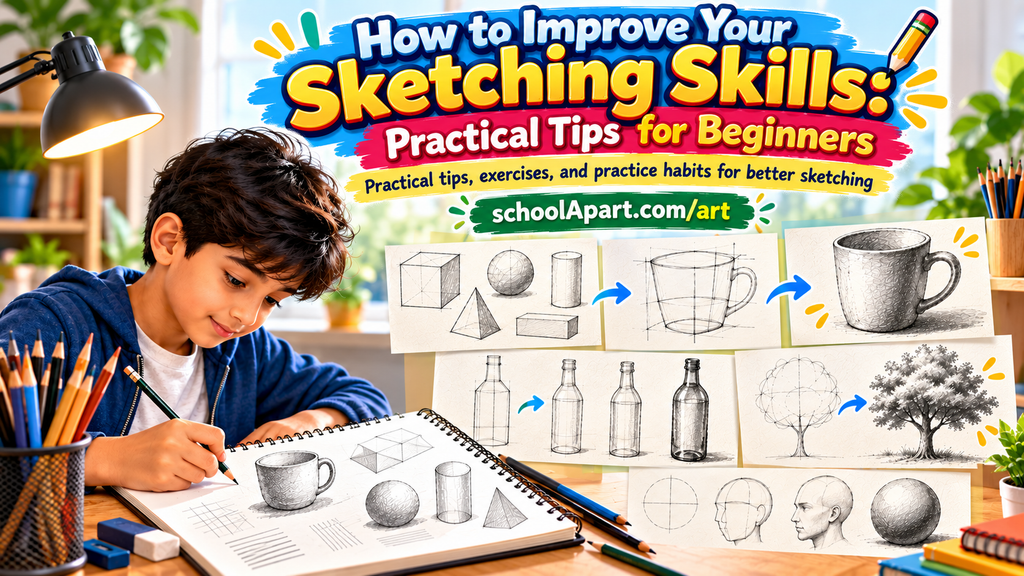
Practice Basic Shapes
Many complicated subjects can be simplified into basic shapes.
For example:
- A book can begin as a rectangle.
- A ball can begin as a circle.
- A bottle can be simplified into rectangles and ovals.
- A box can be constructed from simple geometric forms.
- A fruit can often begin with a circle or oval.
Practicing basic shapes helps you understand structure before adding details.
If you need to strengthen this foundation, see:
You can also practice:
How to Draw Using Basic Shapes
Improve Your Line Control
Good line control can make sketching feel more comfortable and confident.
You can practice:
- Straight lines
- Curved lines
- Short lines
- Long lines
- Parallel lines
- Light lines
- Dark lines
- Continuous lines
- Broken lines
Do not worry about making every line perfect.
The goal is to become more comfortable controlling the pencil.
Simple Line Exercise
Fill a page with rows of:
- Horizontal lines
- Vertical lines
- Diagonal lines
- Curved lines
- Circles
- Spirals
- Waves
Try to keep the spacing reasonably consistent.
A few minutes of this practice can be useful as a warm-up before sketching.
Learn to Sketch Lightly First
One common beginner habit is pressing the pencil too hard from the beginning.
This can make corrections difficult.
Instead, begin with light construction lines.
Use them to establish:
- Overall shape
- Height
- Width
- Position
- Major divisions
- Basic forms
Once the structure looks correct, gradually strengthen the important lines.
This approach gives you more freedom to adjust the drawing.
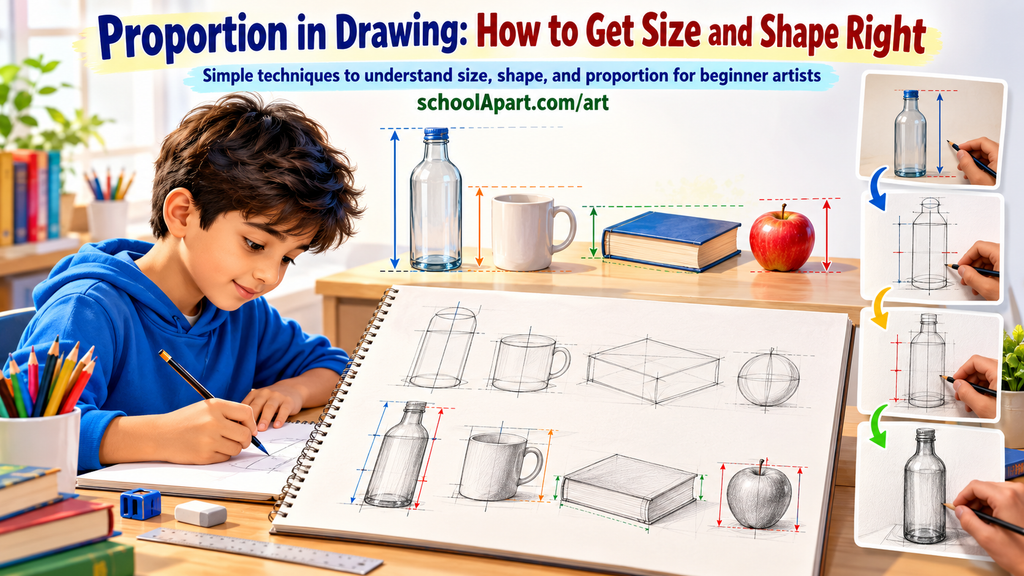
Pay Attention to Proportion
Proportion is an important part of accurate sketching.
It describes how the size of one part relates to another.
For example, when sketching a bottle, you might compare:
- Overall height and width
- Neck size and body size
- Opening and body width
- Base width and body width
Instead of trying to measure everything exactly, compare different parts visually.
For a deeper explanation, see:
Proportion in Drawing: How to Get Size and Shape Right
Practice Drawing What You See
One of the most effective ways to improve sketching is to draw real objects.
Choose simple objects around you, such as:
- Cup
- Bottle
- Book
- Pencil
- Shoe
- Fruit
- Plant leaf
- Small box
- Toy
- School bag
Place the object in front of you and sketch it.
Try not to rely on memory.
Look at the object repeatedly while drawing.
This helps train your observation skills.
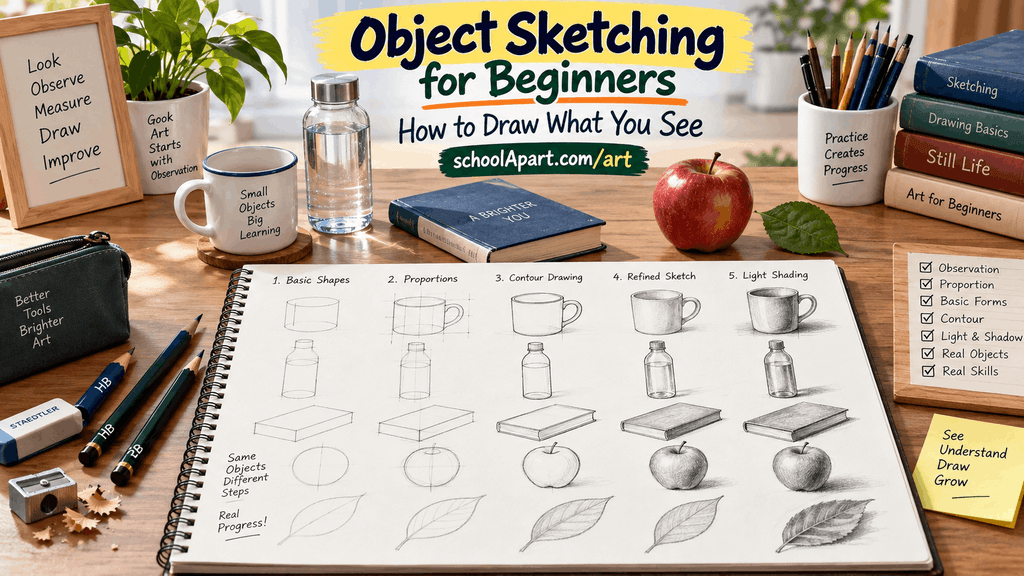
Try Object Sketching
Once you are comfortable with simple shapes, start sketching complete objects.
Begin with objects that have relatively simple structures.
A useful process is:
Observe → Simplify → Construct → Compare → Refine
Start by identifying the basic forms.
Then check the proportions before adding details.
For additional practice:
Object Sketching for Beginners: How to Draw What You See
Practice Different Types of Lines
Not every line in a sketch needs to look the same.
You can use different line qualities to communicate form.
For example:
- Light lines for construction
- Darker lines for important edges
- Short lines for texture
- Curved lines for rounded forms
- Broken lines for subtle edges
Experiment with pressure and movement.
This can make your sketches more expressive without requiring complicated techniques.
Learn Basic Shading
Shading helps communicate light, form, and depth.
You do not need advanced shading skills to begin.
Start by learning to recognize:
- Light areas
- Mid-tones
- Dark areas
- Cast shadows
Then practice simple shading techniques.
You can learn more from:
Shading Techniques for Beginners
When practicing, focus on creating a gradual transition between lighter and darker areas rather than immediately trying to make highly detailed textures.
Use Simple Objects for Shading Practice
A sphere, cube, cylinder, and cone are useful subjects for practicing light and shadow.
For each form:
- Draw the basic shape.
- Choose a light direction.
- Identify the light side.
- Identify the shadow side.
- Add a cast shadow.
- Gradually build darker areas.
This helps you understand how shading describes three-dimensional form.
Practice Negative Space
Sometimes it is easier to understand an object by looking at the empty spaces around and inside it.
These empty areas are called negative spaces.
For example, when sketching a chair, observe:
- Space between the legs
- Space under the seat
- Space between the backrest and seat
Instead of focusing only on the chair, look at these spaces too.
If the negative spaces in your drawing look different from the reference, your proportions or positioning may need adjustment.
Sketch From Different Angles
Do not always draw an object from the same viewpoint.
Once you become comfortable, try sketching it:
- From the front
- From the side
- From above
- From a slightly lower angle
- From a slightly higher angle
This helps you understand how shape and proportion change with viewpoint.
It also makes your sketching practice more interesting.
Use References Wisely
Reference images can be extremely useful for beginners.
You can use:
- Your own photographs
- Objects around your home
- School objects
- Simple reference pictures
- Publicly available educational references
When using a reference, do not focus only on copying the outline.
Study:
- Shapes
- Proportions
- Angles
- Light
- Shadow
- Negative space
- Relationships between parts
The goal is to develop observation skills, not simply reproduce one picture.
Practice Sketching From Memory Too
Drawing from observation should be a major part of your practice, but drawing from memory can also be useful.
Try this exercise:
- Observe a simple object for one or two minutes.
- Put it away.
- Sketch what you remember.
- Bring the object or reference back.
- Compare your drawing with it.
You may discover that your memory simplified or changed certain shapes.
That comparison can help you understand what you need to observe more carefully.
Avoid Erasing Too Much
Erasing is useful, but constantly erasing every imperfect line can interrupt the learning process.
Sometimes it is better to:
- Keep light construction lines
- Compare your shapes
- Correct major errors
- Continue the drawing
- Review it afterward
Your sketchbook is a place for practice, not just finished artwork.
Some imperfect sketches are valuable because they show you what you need to improve.
Draw the Same Object More Than Once
Repeating the same subject can be surprisingly useful.
For example:
First sketch: Focus on overall shape.
Second sketch: Focus on proportion.
Third sketch: Focus on light and shadow.
Fourth sketch: Try to improve the entire drawing.
Compare the four sketches.
This makes improvement easier to notice.
Try Timed Sketches
Timed sketching can help you become more confident and less dependent on excessive detail.
Try:
- 2-minute sketch
- 5-minute sketch
- 10-minute sketch
- 15-minute sketch
Start with a simple subject.
The purpose is not to create a perfect finished drawing.
Instead, focus on capturing:
- Overall shape
- Major forms
- Proportion
- Main light and dark areas
Practice With a Sketchbook
Keeping a dedicated sketchbook makes practice easier to organize.
You can use it to record:
- Daily sketches
- Object studies
- Shape exercises
- Shading exercises
- Quick sketches
- Failed attempts
- Improved versions
Do not tear out every drawing you dislike.
Keeping older sketches allows you to look back later and see how your skills have changed.
Create a Simple Daily Sketching Routine
You do not need a long practice session every day.
A simple 15-minute routine can work well for beginners.
3 Minutes — Warm-Up
Practice:
- Lines
- Circles
- Curves
- Simple shapes
5 Minutes — Observation
Choose one simple object and study its:
- Shape
- Proportion
- Angles
- Major parts
5 Minutes — Sketch
Draw the object using light construction lines first.
2 Minutes — Review
Ask:
- Is the overall shape correct?
- Is the proportion reasonable?
- Which part looks inaccurate?
- What can I improve next time?
This routine is short enough to repeat regularly.
A Weekly Sketching Practice Plan
If you want a slightly more structured approach, try this:
| Day | Practice |
|---|---|
| Monday | Line control and basic shapes |
| Tuesday | Simple object sketching |
| Wednesday | Proportion practice |
| Thursday | Light and shadow |
| Friday | Timed sketch |
| Saturday | Still life sketch |
| Sunday | Review and redraw |
You can adjust the schedule based on your time and interests.
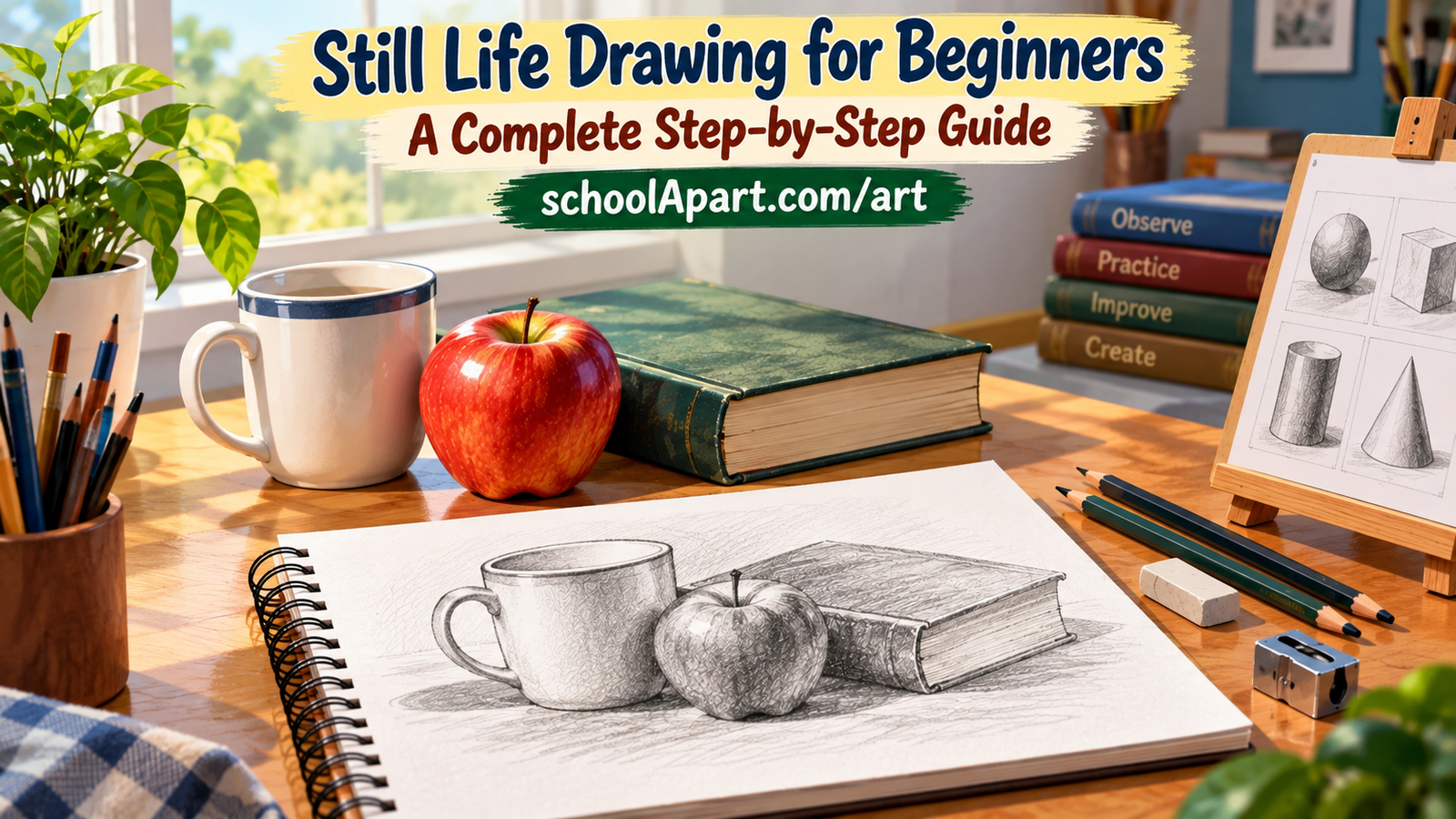
Try Still Life Sketching
Still life drawing is excellent for improving observation.
Arrange two or three simple objects, such as:
- A cup
- A book
- A fruit
Then observe their relative:
- Height
- Width
- Position
- Distance
- Shape
Start with simple construction and gradually add details.
For a complete guide, see:
Still Life Drawing for Beginners: A Complete Step-by-Step Guide
Compare Your Old and New Sketches
One of the easiest ways to notice improvement is to compare your work over time.
Keep some sketches from different stages of your practice.
Look for changes in:
- Line confidence
- Shape accuracy
- Proportion
- Shading
- Detail control
- Observation
Do not compare your work only with professional artists.
Compare your current work with your own earlier work.
That gives you a more useful picture of your progress.
Common Mistakes That Can Slow Your Progress
Practicing Only One Type of Drawing
Drawing the same subject repeatedly can limit the skills you develop.
Try different objects and viewpoints.
Focusing Too Much on Detail
Details cannot fix an incorrect overall structure.
Work from large shapes to smaller details.
Avoiding Difficult Subjects
It is fine to start simple, but gradually introduce new challenges.
Expecting Fast Results
Drawing skills develop through repeated practice.
Comparing Yourself With Advanced Artists
Use other artists for inspiration and learning, but focus primarily on your own progress.
Skipping Observation
If you draw without looking carefully, you may repeat the same mistakes.
How Long Does It Take to Improve Sketching?
There is no fixed amount of time because everyone practices differently.
You may notice small improvements after regular practice, but developing strong sketching skills takes time.
Instead of asking:
“How quickly can I become good at sketching?”
try asking:
“What specific skill can I improve today?”
For example:
- Better circles
- More confident lines
- More accurate proportions
- Better observation
- Smoother shading
Small improvements add up over time.
10 Practical Tips to Improve Sketching
Remember these simple tips:
- Observe before drawing.
- Start with basic shapes.
- Use light construction lines.
- Compare height and width.
- Practice line control.
- Draw real objects from observation.
- Learn basic light and shadow.
- Check negative spaces.
- Keep a regular sketchbook practice.
- Review old sketches to track progress.
Improving your sketching skills is not about drawing complicated pictures as quickly as possible.
It is about becoming better at seeing, understanding, and representing what you observe.
Start with basic shapes and simple objects. Practice proportion, line control, light and shadow, and observation. Use short, focused exercises instead of relying only on finished drawings.
Most importantly, keep your sketches.
Some drawings will look better than others. That is a normal part of learning.
Every sketch gives you another opportunity to understand what works, what needs improvement, and what you can try next.
With regular practice and patience, your sketching can become more confident, accurate, and expressive.
Quick Takeaway
Better sketching comes from better observation and focused practice.
Use this simple cycle:
Observe → Simplify → Sketch → Compare → Correct → Practice Again
Frequently Asked Questions
How can I improve my sketching skills?
Practice observation, basic shapes, line control, proportion, shading, and object sketching regularly. Short focused practice sessions can be very effective.
How often should beginners practice sketching?
Regular practice is more useful than occasional long sessions. A short 10–15 minute practice routine can be a good starting point.
What should I practice first to improve sketching?
Start with observation, basic shapes, and line control before moving to more detailed subjects.
How can I improve my pencil sketching?
Practice different pencil pressures, line types, basic shapes, proportions, light and shadow, and simple real objects.
Why do my sketches look inaccurate?
Inaccurate observation, incorrect proportions, and starting with details too early are common reasons. Compare your drawing with the reference and check the overall structure.
Is drawing from real objects better for learning sketching?
Drawing real objects is very useful because it teaches you to observe actual shapes, proportions, angles, and light rather than relying only on memory.
How can I improve my observation skills for sketching?
Spend time looking at the subject before drawing. Study its overall shape, proportions, angles, negative spaces, and relationships between parts.
Should I use references when practicing?
Yes. References can help beginners study shapes, proportions, light, and structure. Real objects can also be excellent references.
How long should a beginner sketch each day?
Even 10–15 minutes of focused practice can be useful. You can increase the practice time as your interest and experience grow.
Are sketching exercises useful for beginners?
Yes. Exercises for lines, shapes, proportions, shading, and observation help develop individual skills before combining them in complete sketches.
How can I make my sketching lines more confident?
Practice controlled lines regularly and avoid repeatedly correcting every line. Starting with light construction lines can also make drawing feel more comfortable.
Should I erase mistakes while sketching?
You can erase when necessary, but do not feel that every imperfect line must be removed. Construction lines and corrections are a normal part of learning.
Can I improve sketching without taking an art class?
Yes. Regular practice, careful observation, useful references, and structured exercises can help you develop many foundational sketching skills independently.
How do I know if my sketching is improving?
Compare newer sketches with older ones. Look for changes in line control, proportions, observation, shading, and confidence.
What objects are good for beginner sketching practice?
Cups, bottles, books, fruits, pencils, boxes, shoes, leaves, and other simple household or school objects are good starting subjects.



Leave a Reply