
Discover easy science project craft ideas for school students, including Solar System, Water Cycle, Volcano, Plant Cell, Rainwater Harvesting and more.
Easy Science Project Craft Ideas for School Students: Simple, Creative & Educational Models
Science is not only about reading textbooks and memorizing facts. When students build a science project with their own hands, they can understand how scientific ideas work in a more practical and interesting way.
For school students, a good science project does not always need expensive materials or complicated technology. A simple model made with cardboard, paper, clay, recycled materials, bottles, sticks, colours and other easily available materials can be a useful way to present a science concept.
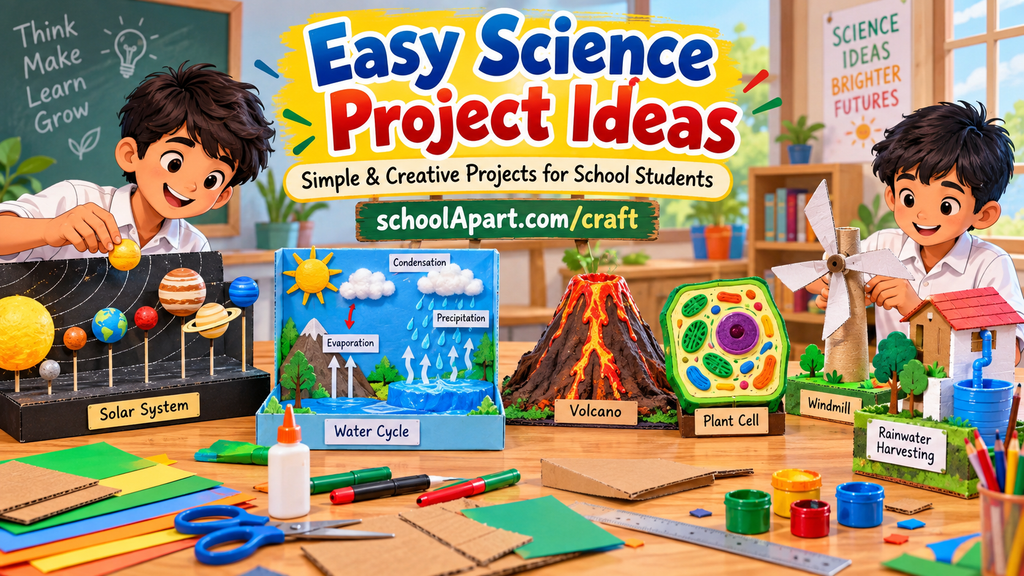
This guide brings together easy science project ideas for school students that can be adapted for classroom activities, school exhibitions, science fairs, homework, assignments and project work.
Many commonly used school-project themes include the solar system, water cycle, volcanoes, plant models, water filtration, rainwater harvesting and renewable energy.
Why Make Science Projects at School?
Science projects can help students connect what they learn in class with something they can see, build, demonstrate and explain.
A hands-on project can help students practise:
- Creative thinking
- Problem-solving
- Observation
- Basic research
- Model-making
- Presentation skills
- Planning and organization
- Scientific communication
- Fine motor skills
- Teamwork
A school science project is therefore not simply about making a beautiful model. The most useful project is one where the student understands what the model represents and how the science works.
20 Easy Science Project Craft Ideas for School Students
Here are some beginner-friendly project ideas that can be adapted according to the student’s class level, school instructions and available materials.
1. ☀️ Solar System Model
A Solar System Model is one of the most familiar school science projects and can be created as a 2D chart, hanging model or 3D craft model.
Materials You May Need
- Cardboard
- Paper or thermocol balls
- Paint or coloured paper
- String
- Glue
- Scissors
- Markers
What Students Can Learn
The model can be used to introduce:
- The Sun
- The planets
- Planet order
- Relative size
- Orbits
- Basic Solar System structure
Students can make the model more educational by adding labels and short facts about each planet.
2. 💧 Water Cycle Model
A Water Cycle Model can visually explain how water moves through different stages in nature.
Main concepts
- Evaporation
- Condensation
- Precipitation
- Collection
Students can create a simple 3D scene using cardboard, cotton, paper, clay and colours.
Craft idea
Use cotton for clouds, blue paper for water, cardboard for mountains and arrows to show the movement of water.
Water-cycle models are commonly used in school science exhibitions because they allow students to visually represent evaporation, condensation and precipitation.
3. 🌋 Volcano Model
A volcano model combines science learning with creative model making.
Students can build a small volcano using materials such as:
- Cardboard
- Paper
- Clay or paper mache
- Paint
- Baking soda
- Vinegar
The model can be used to explain what a volcano is and how an eruption demonstration works.
Science concept
The familiar baking-soda-and-vinegar demonstration produces carbon dioxide gas through a chemical reaction. School project resources commonly use this as a simple introductory volcano demonstration.
Safety: Younger students should perform demonstrations with adult or teacher supervision.
4. 🌱 Plant Cell Model
A Plant Cell Model is a useful biology project for showing the major parts of a plant cell.
Students can create a 3D model using:
- Coloured clay
- Cardboard
- Paper
- Foam
- Recycled materials
Important parts can be labelled, such as:
- Cell wall
- Cell membrane
- Nucleus
- Cytoplasm
- Chloroplast
- Vacuole
The objective is not just to make a colourful model but to understand what each part represents.
5. 🧫 Animal Cell Model
Students can create an Animal Cell Model in a similar way.
A 3D model can help students identify structures such as:
- Cell membrane
- Nucleus
- Cytoplasm
- Mitochondria
- Ribosomes
- Endoplasmic reticulum
- Golgi apparatus
Clay is particularly useful for creating the different structures in a simple 3D format.
6. ❤️ Human Heart Model
A simple Human Heart Model can be used to introduce the basic structure of the heart and blood circulation.
Students can use:
- Cardboard
- Coloured paper
- Clay
- Straws or tubes
- Red and blue materials
A more advanced working model can demonstrate the movement of fluid through tubes.
For younger students, however, a clearly labelled 3D model may be enough.
7. 🌧️ Rainwater Harvesting Model
Rainwater harvesting is an excellent project because it connects science with an everyday environmental issue.
The model can show:
Roof → Pipe → Filter → Storage Tank → Reuse
Students can create a miniature house using cardboard and show how rainwater flows from the roof into a collection tank.
Materials
- Cardboard
- Plastic bottle/container
- Straws or small tubes
- Paper
- Glue
- Clay
- Colours
Rainwater-harvesting models are regularly used in school science-project and exhibition resources.
8. ♻️ Water Filtration Model
A simple water filtration model can demonstrate the basic idea of filtering water through different materials.
Students may use:
- A transparent bottle
- Gravel
- Sand
- Cotton
- Activated charcoal
- Water
The project can explain the basic concept of filtration.
Important note
A homemade filter demonstration should not be presented as a method for making unsafe water safe to drink. The project is primarily an educational demonstration.
Water purification and filtration models are common school exhibition topics.
9. 🌳 Plant Life Cycle Model
Show the stages of a plant’s growth using a simple 3D craft model.
Stages
Seed → Germination → Seedling → Young Plant → Mature Plant → Flower/Fruit → Seed
Students can use:
- Clay
- Paper
- Cardboard
- Seeds
- Natural materials
This project is particularly suitable for younger students.
10. 🦋 Butterfly Life Cycle Model
Create a colourful model showing:
Egg → Caterpillar → Pupa → Butterfly
Students can use clay, paper, cardboard or recycled materials.
This project is simple enough for primary students and can combine science learning with craft skills.
11. 🍃 Food Chain Model
A food chain model can help students understand how energy and food relationships move through an ecosystem.
For example:
Grass → Grasshopper → Frog → Snake → Eagle
Students can create a 3D ecosystem scene using:
- Cardboard
- Paper
- Clay
- Small recycled materials
- Labels
The exact food chain can be adapted to the student’s class level.
12. 🌍 Ecosystem Diorama
An ecosystem diorama is a creative science project that combines model making, environmental science and visual storytelling.
Possible themes include:
- Forest ecosystem
- Pond ecosystem
- Desert ecosystem
- Ocean ecosystem
- Grassland ecosystem
Students can create the environment inside a cardboard box and add plants, animals, landforms and labels.
13. 🌬️ Wind Energy Model
A small Wind Energy Model can introduce the concept of renewable energy.
Students can make a simple windmill using:
- Cardboard
- Paper
- Wooden sticks
- A small motor, if appropriate
- Wires and an LED for a more advanced model
A working version can demonstrate how mechanical movement can be converted into electrical energy.
Wind turbines and renewable-energy models are frequently used in school science exhibitions.
14. ☀️ Solar Energy Model
Students can create a simple model demonstrating how sunlight can be used as an energy source.
A project might represent:
Sun → Solar Panel → Electricity → Device
For older students, a small solar panel can be incorporated into a working model.
For younger students, a paper or cardboard model explaining the concept may be more appropriate.
15. ⚡ Simple Electric Circuit Model
A basic electric circuit can demonstrate how electricity flows through a complete circuit.
A simple model may contain:
- Battery
- Wires
- Small bulb or LED
- Switch
Students can create the circuit on a cardboard base and label each component.
Main concept
Source → Wire → Switch → Load → Complete Circuit
Electrical circuit models are widely used in school science activities and exhibitions.
16. 🧲 Magnet and Compass Model
This project can introduce basic ideas about magnetism and direction.
Students can create a simple display showing:
- Magnet
- Magnetic field concept
- Compass
- North and South direction
A needle-based compass activity should be done carefully and under appropriate supervision.
17. 🌡️ Weather Station Model
Students can create a miniature weather station showing different instruments and observations.
It can include representations of:
- Thermometer
- Rain gauge
- Wind vane
- Anemometer
- Cloud/rain symbols
For a simple school craft project, students do not need every instrument to be functional.
The aim can simply be to understand how different weather conditions are observed.
18. 🌊 Water Pollution Model
Create a 3D scene showing the difference between a clean water source and a polluted water source.
The model can show:
Clean Water → Pollution Sources → Effects → Prevention
Possible pollution sources can include:
- Plastic waste
- Industrial waste
- Household waste
- Sewage
Students can use recycled materials to make the model more meaningful.
19. 🌱 Soil Erosion Model
A simple soil erosion model can demonstrate how water or wind can move soil.
Students can create two small land areas:
- One with vegetation
- One without vegetation
Then the project can visually explain why plant cover can help reduce soil erosion.
This is especially useful for environmental science and geography-related school projects.
20. 🫁 Human Respiratory System Model
A simple respiratory-system model can help students understand the basic pathway of air.
A craft-based model can include:
- Nose
- Trachea
- Bronchi
- Lungs
- Diaphragm
Older students can create a simple working demonstration using balloons and a bottle to represent the basic movement involved in breathing.
🎯 How to Choose the Right Science Project
Before choosing a project, students should ask:
1. What is my class level?
A primary-school student does not need the same complexity as a Class 9 or Class 10 student.
2. What is the school asking for?
Check whether the teacher wants:
- A chart
- A static model
- A 3D model
- A working model
- An experiment
- A research project
3. Can I explain the science?
This is extremely important.
Do not choose a complicated model just because it looks impressive.
A simple project that you understand and can explain clearly can be more useful for learning than a complex model whose working you cannot explain. Current school-exhibition guidance also emphasizes understanding the scientific concept and explaining the project clearly.
4. Are the materials easily available?
Whenever possible, choose affordable and easily available materials.
5. Can I make it neatly?
A good project should be:
- Clean
- Well-labelled
- Organized
- Easy to understand
- Safe to handle
🛠️ Basic Materials for School Science Craft Projects
You can build many school science models using a small collection of basic materials.
Paper & Board
- Cardboard
- Chart paper
- Coloured paper
- Newspaper
- Paper cups
- Paper rolls
Modelling Materials
- Clay
- Modelling dough
- Cotton
- Foam sheets
Recycled Materials
- Plastic bottles
- Bottle caps
- Boxes
- Old containers
- Ice cream sticks
Basic Tools
- Scissors
- Glue
- Tape
- Pencil
- Ruler
- Markers
- Paintbrushes
- Colours
For younger children, sharp tools, hot glue, electrical components and chemical demonstrations should be handled with appropriate adult or teacher supervision.
💡 How to Make Your Science Project More Creative
A science project does not have to be complicated to look interesting.
Try these simple improvements:
Add clear labels
Every important part should have a readable label.
Use arrows
Arrows can show:
- Movement
- Direction
- Process
- Flow
Add a short explanation
Keep a small information card beside the model.
Use colour carefully
Use different colours to distinguish different parts instead of decorating everything randomly.
Add a “How It Works” section
A small explanation can make the project much easier to understand.
Use recycled materials
Using cardboard, paper and other reusable materials can make the project both economical and creative.
📋 Simple Science Project Presentation Format
If you are preparing a school project, you can organize the presentation like this:
Project Title
↓
Introduction
↓
Objective
↓
Materials Required
↓
How to Make the Model
↓
How It Works
↓
Science Behind It
↓
What We Learned
↓
Conclusion
This structure works particularly well for school exhibitions and classroom presentations.
⭐ Key Takeaways
- Choose a project according to your class level and school requirements.
- A simple project can be highly educational.
- Understand the science before making the model.
- Use affordable and easily available materials whenever possible.
- Label important parts clearly.
- Keep the project neat and organized.
- Use recycled materials where appropriate.
- Never perform potentially unsafe experiments without teacher or adult supervision.
- Most importantly, make the project yourself and understand what you are presenting.
Science projects give school students an opportunity to turn classroom learning into something they can build, observe and explain.
From a simple Solar System Model or Water Cycle Model to a Rainwater Harvesting System, Plant Cell, Food Chain, Water Filtration Model or Renewable Energy Project, there are many ways to combine science with creative craft skills.
The best school science project is not necessarily the biggest or most complicated one. It is a project that is appropriate for the student’s level, clearly presented, scientifically understandable and made with care.
Start with a simple idea, gather your materials, plan the model and build it step by step. As your skills improve, you can move toward more detailed and creative working models.
FAQ
1. What are some easy science project ideas for school students?
Some easy ideas include a Solar System Model, Water Cycle Model, Volcano Model, Plant Cell Model, Rainwater Harvesting Model, Food Chain Model and simple Electric Circuit Model.
2. Which science project is best for beginners?
Simple projects such as the Solar System, Plant Life Cycle, Water Cycle and Food Chain are suitable starting points because they can be made using basic craft materials.
3. What materials are commonly used for school science projects?
Cardboard, coloured paper, clay, glue, cotton, recycled boxes, plastic bottles, sticks, markers and basic craft supplies can be used for many school projects.
4. Can I make a science project using waste materials?
Yes. Cardboard boxes, newspaper, paper rolls, bottle caps and other reusable materials can be used to create many educational science models.
5. How can I make my science project attractive?
Use clear labels, organized colours, arrows, a neat base and a short explanation of how the model works.
6. What is a good science project for a school exhibition?
A good exhibition project should match the student’s class level, demonstrate a clear science concept and be easy for the student to explain.
7. How do I choose a science project for my class?
Consider your class level, the topic taught in school, the teacher’s instructions, available materials and how confidently you can explain the science behind the model.
8. Are working models necessary for every science project?
No. Some assignments require a working model, while others may require a chart, static 3D model, experiment or research project. Always check the school instructions first.
9. Can younger children make science models?
Yes. Younger students can make simple models such as plant life cycles, butterfly life cycles, the Solar System and basic weather or animal projects with suitable adult supervision.
10. What makes a good school science project?
A good project is age-appropriate, scientifically understandable, neat, clearly labelled and properly explained.
11. Can clay be used for science projects?
Yes. Clay is useful for making 3D models such as cells, planets, landforms, plants, animals and other science structures.
12. Can paper be used for science projects?
Yes. Paper and cardboard can be used for charts, diagrams, 3D models, Solar System projects, life-cycle models and many other school projects.
13. What is a good environmental science project?
Rainwater harvesting, water pollution, water filtration, recycling, soil erosion and renewable-energy models are useful environmental project themes.
14. Should students buy expensive materials?
Not necessarily. Many school science models can be created with affordable craft supplies and reusable household materials.
15. Should students understand their project before presenting it?
Absolutely. Students should understand the scientific concept, materials, process and conclusion well enough to explain the project in their own words.
Leave a Reply