Learn AI for school students with simple guides on AI basics, learning, creativity, prompts, critical thinking, coding and responsible AI use.
AI for School Students
Learn what AI is, how it works, how students can use it for learning and creativity, and how to use AI responsibly.
Artificial Intelligence is becoming an important part of the world students live and learn in. From search engines and recommendation systems to AI-powered learning tools and creative applications, students are increasingly interacting with AI in everyday life.
But learning about AI should not simply mean learning how to use an AI tool.
Students also need to understand what AI is, what it can and cannot do, how to ask better questions, how to check AI-generated information, how to protect their privacy, and how to use AI without replacing their own thinking.
That is the purpose of the SchoolApart AI section.
AI should not replace a student’s thinking. AI should support a student’s learning, creativity, problem-solving and productivity.
Our Approach to AI Learning
At SchoolApart, we follow a simple learning journey:
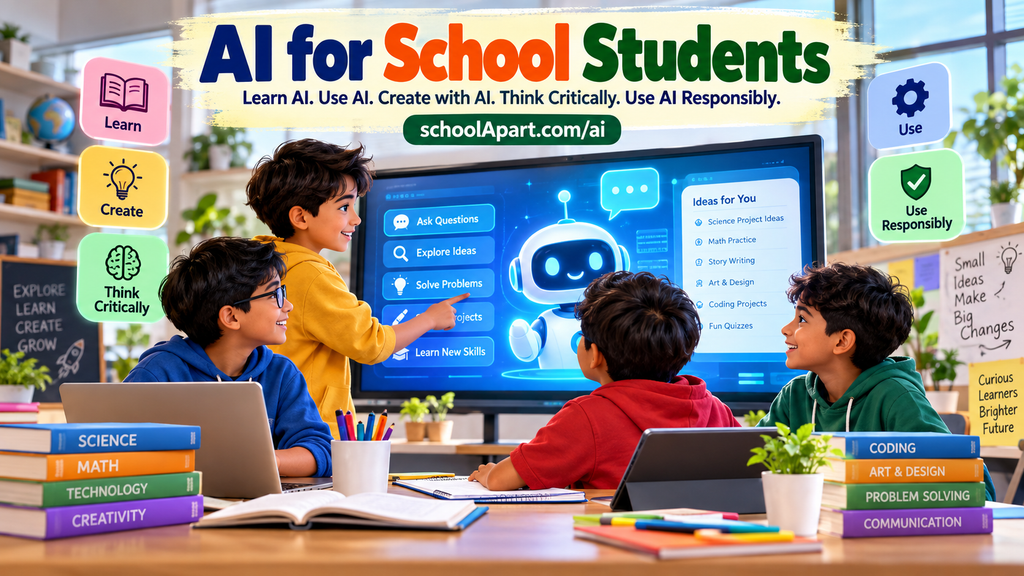
Understand AI → Use AI → Create with AI → Think Critically About AI → Use AI Responsibly
This approach helps students move beyond simply using AI tools and develop the knowledge and skills needed to become confident and responsible users of AI.
UNESCO’s AI competency framework for students similarly emphasizes foundational understanding, practical application, creativity, ethics and critical judgement as important parts of student AI education.
What Is AI?
Artificial Intelligence, or AI, refers to computer systems that can perform tasks that normally require some form of human intelligence.
These tasks may include:
- Understanding or generating language
- Recognizing images
- Finding patterns in information
- Making predictions
- Recommending content
- Generating text, images, audio or other content
- Helping users solve problems
Students already encounter AI in many everyday technologies, sometimes without realizing it.
Understanding these systems is the first step toward becoming AI literate.
Why Should Students Learn AI?
AI is becoming part of education, creativity, communication, technology and many future careers.
Learning AI can help students develop skills such as:
- Problem-solving
- Critical thinking
- Creativity
- Research skills
- Digital literacy
- Communication
- Question-asking
- Information evaluation
- Technology awareness
- Responsible decision-making
The goal is not to make students dependent on AI.
The goal is to help students understand when AI can help, when it should not be trusted, and when human thinking must come first.
Learn AI — Understand How It Works
The first stage is building a basic understanding of AI.
Students can explore questions such as:
- What is Artificial Intelligence?
- How does AI work?
- What is Generative AI?
- What is Machine Learning?
- What is an AI model?
- What is a chatbot?
- How does AI generate answers?
- How does AI recognize patterns?
- How do recommendation systems work?
- What can AI do?
- What can AI not do?
These concepts can be introduced through simple explanations, examples and age-appropriate activities.
The aim is to make AI understandable rather than intimidating.
Use AI for Learning
AI can be used as a learning assistant when students use it thoughtfully.
For example, students may use AI to:
- Understand a difficult concept
- Get another explanation of a topic
- Generate practice questions
- Create a revision quiz
- Brainstorm ideas
- Organize study topics
- Practice writing
- Explore different examples
- Ask follow-up questions
- Get help identifying areas they need to study more
However, asking AI to simply provide an answer is not the same as learning.
A better approach is to use AI to understand the answer, question the answer and learn from the process.
For example:
Instead of asking:
“Give me the answer to this homework question.”
A student could ask:
“Explain this concept step by step and then give me a similar question to solve myself.”
This keeps the student involved in the learning process.
Create with AI
AI can also become a creative learning partner.
Students can explore how AI can help them develop:
- Story ideas
- Writing ideas
- Drawing concepts
- Presentation ideas
- Project ideas
- Brainstorming exercises
- Coding projects
- Educational games
- Creative experiments
The important distinction is between creating with AI and simply letting AI create everything.
Students should contribute their own ideas, make decisions, edit results and improve the final work.
AI can provide possibilities.
The student should provide the thinking.
Learn the Skill of Prompting
One useful AI skill for students is learning how to communicate clearly with AI systems.
A prompt is an instruction or question given to an AI system.
Students can learn how to make prompts more useful by explaining:
- What they want
- Why they need it
- The level of difficulty
- The format they want
- Important limitations
- Examples when necessary
For example, instead of:
“Explain photosynthesis.”
A more useful learning prompt could be:
“Explain photosynthesis in simple language for a school student. Use a simple example and then give me five questions to test my understanding.”
Learning to ask better questions can improve both AI interaction and general communication skills.
Think Critically About AI
AI can produce useful answers, but an AI-generated answer is not automatically correct.
Students should learn to ask:
- Is this information correct?
- Where did this information come from?
- Can I verify it from another reliable source?
- Does the answer make sense?
- Could the AI have misunderstood my question?
- Is important information missing?
- Is the AI presenting an opinion as a fact?
- Should I ask a teacher, textbook or trusted source?
This is one of the most important parts of AI literacy.
AI can make mistakes. Students need to learn how to notice and check them.
UNESCO’s student framework specifically highlights critical judgement of AI solutions and responsible participation in the AI era.
Use AI Responsibly
Students should understand that using AI comes with responsibilities.
Responsible AI use includes:
Protecting Personal Information
Students should be careful about entering personal or sensitive information into AI systems.
They should think before sharing:
- Full personal details
- Passwords
- Private messages
- Personal documents
- School records
- Other people’s private information
- Sensitive photographs or files
Privacy and data protection are important parts of child-centred AI guidance from UNICEF.
Being Honest About AI Use
Students should understand the difference between using AI as a learning aid and submitting AI-generated work as their own.
If a school, teacher or assignment has rules about AI use, students should follow those rules.
Checking AI-Generated Information
AI-generated information should be checked before it is treated as fact, particularly for important academic or real-world information.
Keeping Human Judgement
AI can suggest.
AI can explain.
AI can generate.
But students still need to think, decide, evaluate and take responsibility for their work.
Using AI Safely
Students should use AI tools in age-appropriate and safe ways and involve a parent, teacher or trusted adult when they are unsure about an AI system or interaction.
UNICEF’s current guidance on AI and children emphasizes safety, privacy, fairness, transparency, accountability, inclusion and preparing children with appropriate AI skills.
AI Is a Tool — Not a Replacement for Thinking
One of the most important ideas behind SchoolApart AI is simple:
Don’t let AI do all the thinking for you.
A student can use AI to:
Learn → Question → Explore → Practice → Create → Check → Improve
rather than:
Ask AI → Copy → Submit
The first approach builds skills.
The second can reduce the opportunity to develop those skills.
AI should therefore be treated as a learning assistant, creative partner and productivity tool, while the student’s own curiosity, reasoning and judgement remain central.
AI and School Projects
AI can be useful during school projects when it is used appropriately.
Students can use AI to help with:
- Choosing a project topic
- Brainstorming possible ideas
- Understanding background concepts
- Creating research questions
- Planning a project
- Developing presentation ideas
- Improving explanations
- Generating practice questions
- Exploring different approaches
But students should still conduct their own research, verify important information, understand the subject and create their own final work according to their school’s rules.
AI and Creativity
AI can introduce students to new forms of creativity.
Students can experiment with:
- Writing
- Storytelling
- Drawing
- Illustration
- Design
- Presentations
- Coding
- Music and sound concepts
- Educational games
- Creative problem-solving
This creates opportunities to connect the AI section with other SchoolApart skill-development areas such as Art, Coding, Abacus, Personality Development and other creative learning activities.
AI and Coding
AI also creates an opportunity for students to explore coding in a different way.
Students can use AI to:
- Understand programming concepts
- Explain code
- Find simple coding mistakes
- Generate coding exercises
- Brainstorm project ideas
- Build small beginner projects
- Learn through experimentation
But students should try to understand the code instead of blindly copying it.
A useful learning cycle is:
Ask → Read → Understand → Modify → Test → Fix → Learn
This can turn AI into a coding-learning assistant rather than a code-copying machine.
What Students Should Remember
AI is powerful, but it is not perfect.
Students should remember:
- AI can make mistakes.
- AI can misunderstand questions.
- AI-generated information may need verification.
- AI does not replace teachers, textbooks or reliable sources.
- AI should not replace independent thinking.
- Personal information should be protected.
- School and teacher rules about AI should be followed.
- AI should be used to learn and create, not simply to avoid learning.
- Human judgement remains important.
The SchoolApart AI Learning Journey
The SchoolApart AI section will gradually cover five major stages.
1. Understand AI
Learn the fundamentals.
What is AI? How does it work? What are AI systems and generative AI?
2. Use AI
Learn practical ways to use AI for learning, research, creativity and productivity.
3. Create with AI
Use AI as a creative and problem-solving partner while keeping the student’s own ideas at the centre.
4. Think Critically About AI
Learn how to question, verify and evaluate AI-generated information.
5. Use AI Responsibly
Understand privacy, safety, honesty, fairness, human judgement and responsible AI use.
This progression reflects the broader direction of student AI education identified by UNESCO, while SchoolApart adapts it into a practical skill-development pathway for school students.
Explore SchoolApart AI
The SchoolApart AI section will help students gradually build the knowledge and skills they need to understand and use Artificial Intelligence thoughtfully.
From AI basics to prompts, learning, creativity, coding, critical thinking and responsible use, the goal is to make AI education simple, practical and student-focused.
Understand AI. Use AI. Create with AI. Think critically about AI. Use AI responsibly.
The SchoolApart AI Philosophy
AI should not replace a student’s thinking; AI should support a student’s learning, creativity, problem-solving and productivity.
SchoolApart aims to help students become not just AI users, but informed, creative and responsible participants in an AI-powered world.