
Chess For Kids – Discover how Chess helps children develop logic, focus, and strategic thinking through fun brain games. Learn creative ways to teach chess in school and at home with SchoolApart.com.
♟️ Why Chess Matters in Early Learning?
Chess isn’t just a game — it’s a gym for the mind! 🧠
When kids play chess, they’re not only having fun but also developing important life skills like problem-solving, patience, and decision-making.
In today’s world, where focus and concentration are rare, chess brings calm and clarity. That’s why many schools (including ours at SchoolApart.com) encourage chess as part of skill development programs.
🧠 Cognitive Benefits of Chess for Kids
Let’s see what happens inside a child’s brain when they play chess:
✅ 1. Improves Concentration:
Each move in chess requires attention to detail. Children learn to stay calm, observe, and plan their next steps carefully.
✅ 2. Enhances Memory Power:
Kids remember patterns, moves, and strategies. This improves short-term and long-term memory, which also helps in studies.
✅ 3. Builds Logical & Strategic Thinking:
Chess is about thinking ahead — like a puzzle 🎯. Children begin to analyze possibilities, make predictions, and think critically.
✅ 4. Teaches Patience & Decision Making:
Chess teaches that every decision has a consequence. Kids learn to wait, plan, and act wisely, which is a vital life skill.
✅ 5. Boosts Confidence:
Winning a chess game after smart planning gives kids a sense of achievement 🏆 and boosts their self-esteem.
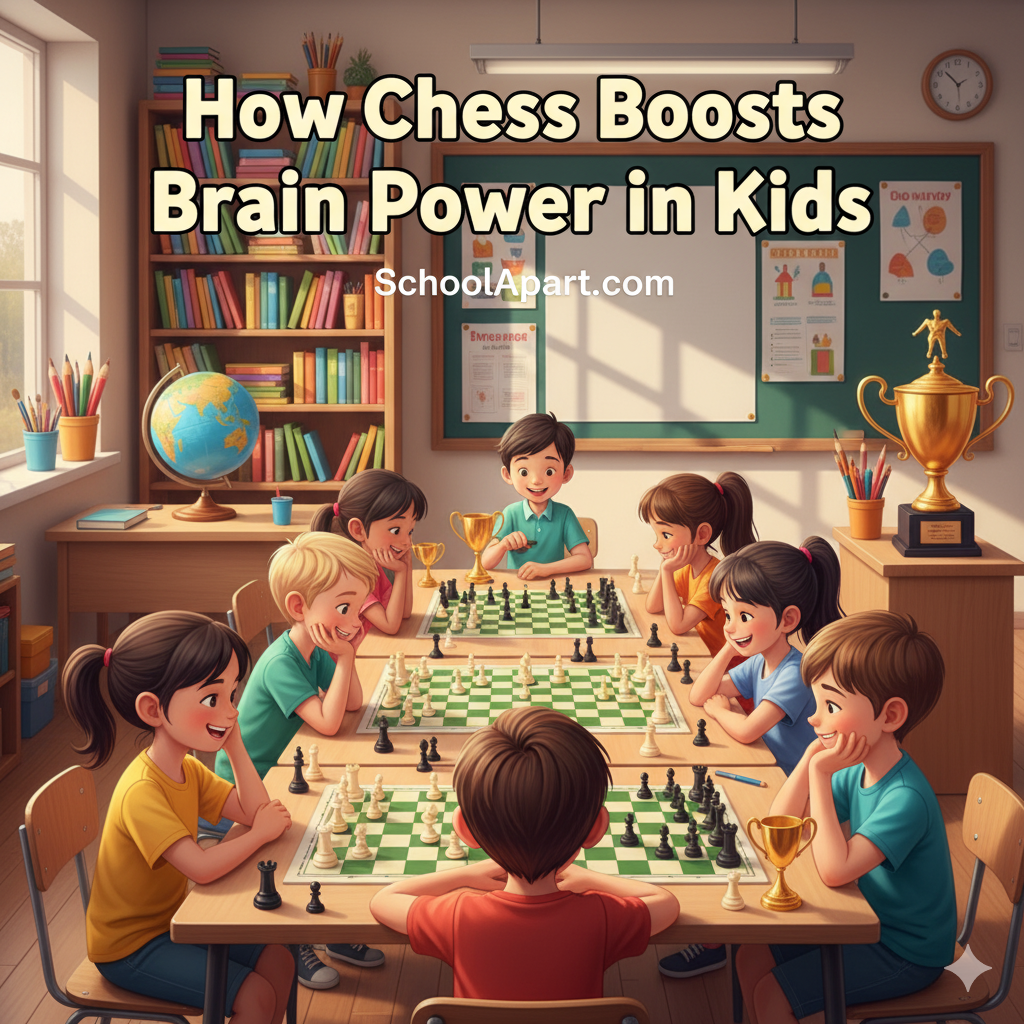
🎯 Chess For Kids | How Chess Boosts Brain Power in Kids
Scientific studies show that children who play chess regularly score higher in mathematical reasoning, logical thinking, and problem-solving tasks.
🧩 It activates both the left brain (logic, reasoning) and the right brain (creativity, imagination) — making it one of the most balanced brain exercises for growing children.
When combined with other brain games like Sudoku, puzzles, or memory cards, chess becomes a fun way to nurture intelligent, strategic minds.
| 🧩 Skill | 💡 How Chess Helps |
|---|---|
| 🧠 Critical Thinking | Kids learn to think before acting and evaluate outcomes. |
| 🎯 Focus & Patience | Chess improves attention span and teaches self-control. |
| 🔍 Problem Solving | Every move requires logical thinking and foresight. |
| 👑 Decision Making | Players weigh risks and choose the best possible move. |
| 💬 Confidence & Sportsmanship | Win or lose, chess builds resilience and humility. |
🏫 How to Introduce Chess in Schools or Homes
📍 Start Simple: Begin with teaching the pieces and their movements.
📍 Use Visual Tools: Colorful chessboards or online apps make learning fun.
📍 Play Mini Games: Instead of full matches, start with quick puzzles like “checkmate in one move.”
📍 Encourage Peer Matches: Friendly competitions help teamwork & sportsmanship.
📍 Celebrate Progress: Reward effort, not just victory — keep motivation high! 🌈
🌈 Real-Life Example: Riya’s Chess Journey
Riya, a 10-year-old from Class 5, started playing chess just for fun. Within months, she became more confident in solving math problems and could sit longer during studies without distraction.
Now, she teaches her friends how to think ahead — both on the board and in life! ♟️✨
♟️ Chess For Kids | Fun and Educational Chess Activities for Students
1️⃣ Mini Chess Matches (5-Minute Games)
⏱️ Goal: Teach fast thinking & decision-making
- Kids play 5-minute “mini matches” to learn quick analysis.
- Encourage thinking 2–3 moves ahead 🧩
- Reward smart moves, not just wins. 🏅
🧠 Skill Developed: Fast reasoning, mental agility, focus.
2️⃣ “Guess the Move” Challenge 🎲
🎯 Activity Idea:
- Show students a chessboard setup (from real games or apps).
- Ask them to predict the next best move for White or Black.
- Discuss why certain moves are smarter than others.
💡 Skill Developed: Logical thinking, pattern recognition 🔍
3️⃣ Team Chess Relay 🤝
👫 Activity Idea:
- Divide the class into two teams.
- Each student plays one move, then passes the turn to the next teammate.
- Builds communication & teamwork along with strategy.
💬 Skill Developed: Cooperation, shared strategy, leadership 🧭
4️⃣ Puzzle Time! 🧩
🧠 Activity Idea:
- Give kids simple “Checkmate in One Move” puzzles.
- Gradually increase to “Checkmate in Two” or “Find the Best Move.”
- Use colorful printed chess boards 🟩⬜🟨 for engagement.
💡 Skill Developed: Pattern spotting, critical thinking.
5️⃣ Story Chess 🎭
📖 Fun Twist:
- Turn chess into storytelling!
- Let kids name their pieces — and narrate their journey on the board.
- Helps younger students understand rules while enjoying the story.
🎨 Skill Developed: Creativity, understanding of chess movement, memory boost.
✅ Tips for Parents & Teachers
- Encourage children to play 15–20 minutes of chess daily.
- Praise clever moves, not only victories.
- Use colorful boards and kid-friendly chess apps.
- Organize “Mini Chess Tournaments” in class or online.
- Relate chess strategies to real-life lessons: “Think before you act.”
🏆 The Smart Move for Smart Minds
Chess is not about winning or losing — it’s about thinking, growing, and learning.
By introducing chess early, we give children a lifelong skill — strategic thinking — that helps them in school and beyond.
🌟 “Every pawn has the potential to become a queen — just like every child has the potential to shine.” 🌟
Let’s encourage our kids to play, think, and grow — one move at a time! ♟️💡
🧩 Other Brain Games to Support Chess Skills
| 🧠 Game | ⚙️ Skill Developed |
|---|---|
| Sudoku 🔢 | Logical reasoning & number sequencing |
| Memory Match 🧩 | Concentration & recall |
| Tangram Shapes 🔺 | Spatial awareness |
| Rubik’s Cube 🧊 | Problem solving & patience |
| Ludo / Snakes & Ladders 🎲 | Turn-taking & fair play |

Leave a Reply